Latest News Archive
Please select Category, Year, and then Month to display items
16 September 2026
|
Story Chrystal Francis
|
Photo Supplied
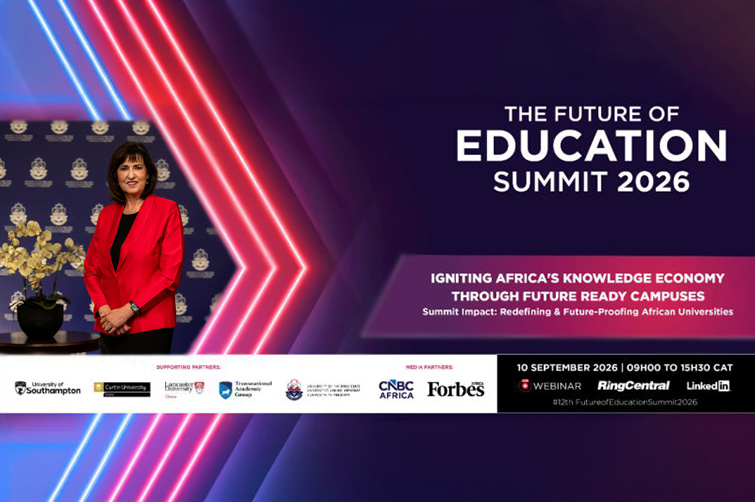 University of the Free State Vice-Chancellor and Principal, Prof Hester C. Klopper, joined Prof Andrew Atherton, Prof Simon Guy, and Prof Deresh Ramjugernath at the 2026 Future of Education Summit to explore how African universities can prepare students for a changing world. Prof Klopper foregrounded access with success, graduate capability, learning design, and the responsible use of artificial intelligence in higher education.
For students, a future-ready university helps them access tertiary education and supports their success once they arrive. It also develops the judgement students need to keep learning as technology changes the world around them.
University of the Free State Vice-Chancellor and Principal, Prof Hester C. Klopper, placed this student experience at the centre of her contribution to the 2026 Future of Education Summit, where she joined university leaders for the panel Reimagining African Universities for a Future-Ready World.
Held under the theme Igniting Africa’s Knowledge Economy Through Future-Ready Campuses, the summit examined how universities can respond to technological change, shifting labour markets, and the growing importance of knowledge to Africa’s development.
Access that leads to success
Prof Klopper described universities as operating in one of the most complex periods they have experienced, with technological change creating what she called a ‘moving target’. She emphasised that for African institutions, this change cannot be considered apart from the realities students bring into higher education, including those entering university from rural communities. The task at hand for higher education institutions is therefore to ensure that institutional responses remain relevant, inclusive, and responsive to context.
Her contribution broadened the discussion of access beyond university admission by situating higher education within a broader educational ecosystem. She argued that access must be understood across the wider education system, including basic education, TVET colleges, community colleges, and universities.
At the University of the Free State, this understanding is reflected in the principle of ‘access with success’, which recognises that opening the doors of higher education must be accompanied by the academic and institutional support students need to progress and succeed.
Prof Klopper also pointed to a shift in what graduates expect from their university education. Summarising what graduates are telling universities, she said: “We don’t just want to be educated, but we want to be capable, we want to be skilled.”
For universities, this requires greater attention to what students are able to do with the knowledge they acquire. It also requires more flexible approaches to qualifications, including micro-credentials, as institutions respond to changing expectations of graduates and the world they are preparing to enter.
Learning with AI, not surrendering learning to it
The panel also considered the growing presence of artificial intelligence in university life, but Prof Klopper’s emphasis was not on technology for its own sake. She argued that higher education has moved beyond debating whether students and staff will use AI, because they already do, and that universities must now focus more carefully on how AI shapes learning.
Drawing on emerging research into AI-supported education, she highlighted that learning design was critical to this task. How technology is incorporated into curricula can determine whether it supports meaningful learning.
Prof Klopper connected this emphasis on learning design to what she termed ‘knowledge agency’ and emphasised the need for stronger evidence through the scholarship of teaching and learning.
Prof Klopper’s argument closely reflected the University of the Free State’s strategic direction, linking academic renewal and AI-enhanced research with the development of graduates prepared for technological change. At the same time, the University’s strategic direction recognises the human capabilities on which sound judgement depends.
Different perspectives on one African challenge
Their contributions addressed participation in higher education, international partnerships, entrepreneurship, and the role universities can play in generating greater value from African research and knowledge.
Prof Klopper’s contribution gave the discussion a clear student-centred focus by emphasising that future readiness will ultimately be experienced in the classroom and in the opportunities that students receive to develop confidence in their own thinking. For the University of the Free State, preparing students for an AI-enabled future means enabling them to use knowledge with judgement and to continue learning long after graduation.