08 April 2026
|
Story Tshepo Tsotetsi
|
Photo Liza Crawley
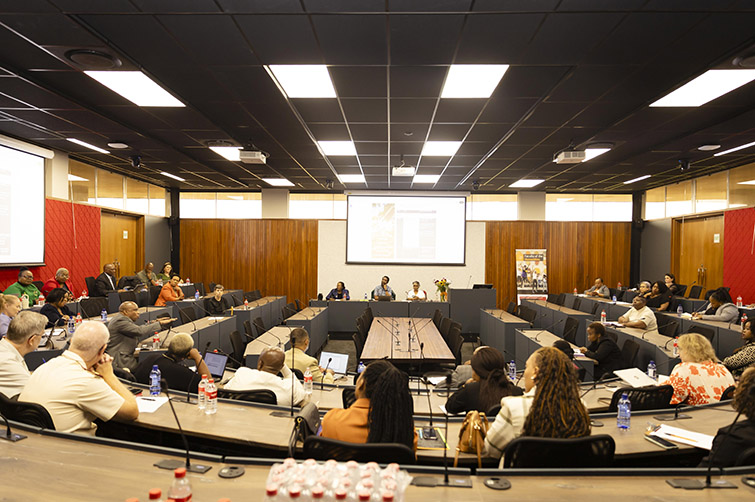 The Department of Social Work at the University of the Free State recently hosted a colloquium bringing together academic and public-sector voices to engage on social-work-graduate employability.
Experts gathered at the University of the Free State (UFS) recently tackled a difficult question about the future of the social work profession: what happens when the system continues to produce graduates without the capacity to absorb them into meaningful employment?
This question formed the centre of a recent colloquium hosted by the Department of Social Work in the UFS Faculty of Humanities, bringing together voices from academia, the public sector, NGO sector, the regulatory body, and academic associations to examine the growing gap between training and opportunity.
The conversation focused on the conditions shaping graduate employability for social workers, with particular attention given to the pressures within the public sector, the realities of the non-profit space, and the limited pathways available to graduates entering the field. Rather than offering simple solutions, the discussions engaged the structural constraints that continue to define the profession.
Rethinking employability in a constrained system
Speaking on the significance of the engagement, Prof Mpumelelo Ncube, Head of the Department of Social Work, emphasised the urgency of confronting these challenges at a systemic level. He reflected on the implications of training graduates into a labour market that cannot fully accommodate them.
“There is nothing as painful as training a social worker and knowing that at the end of the day they may remain unemployed. We must confront whether the system itself has the capacity to absorb them, and what alternatives exist.”
Prof Ncube further located the issue within broader structural conditions affecting the profession.
“These challenges are not merely administrative or economic; they are structural – rooted in how the system itself is organised and sustained.”
The colloquium created space for these concerns to be interrogated beyond institutional boundaries, recognising that employability is shaped by multiple, interconnected systems.
Prof Marlize Rabe, Vice-Dean for Teaching and Learning in the Faculty of the Humanities, situated the discussion within the broader responsibilities the higher education sector holds towards its society. She pointed to the gap between policy intent and lived reality, particularly in relation to social development frameworks.
“We have progressive policies and frameworks that speak to strengthening families and communities. The difficulty lies in implementation, and social workers are central to making that possible.”
She also raised concerns about the vulnerability of graduates within the humanities more broadly, noting the need to reconsider how institutions prepare students for uncertain labour markets.
From a government perspective, Freddy Finger, Chief Director for Corporate Services in the Free State Department of Social Development, outlined the policy environment and constraints shaping employment outcomes. While national frameworks such as the National Development Plan set clear targets, Finger indicated that practical limitations continue to affect the department’s ability to expand employment.
“Budget constraints and the effects of the COVID-19 pandemic have limited our capacity to absorb more graduates. At the same time, the demand for social workers remains significant.”
He pointed to interventions such as internship programmes as part of ongoing efforts to create entry points into the sector, while acknowledging that these measures do not fully address the scale of the challenge.
Across the discussions, a central tension emerged between the recognised need for social workers and the limited capacity of existing systems to employ them. The colloquium highlighted the importance of coordinated responses that extend beyond a single institution or sector, with shared responsibility across government, universities, and the broader social services landscape.
By bringing these perspectives into the conversation, the Department of Social Work has opened space for continued engagement on how the profession can respond to both immediate pressures and longer-term structural realities.