28 August 2026
|
Story Vuyelwa Mbebe
|
Photo Supplied
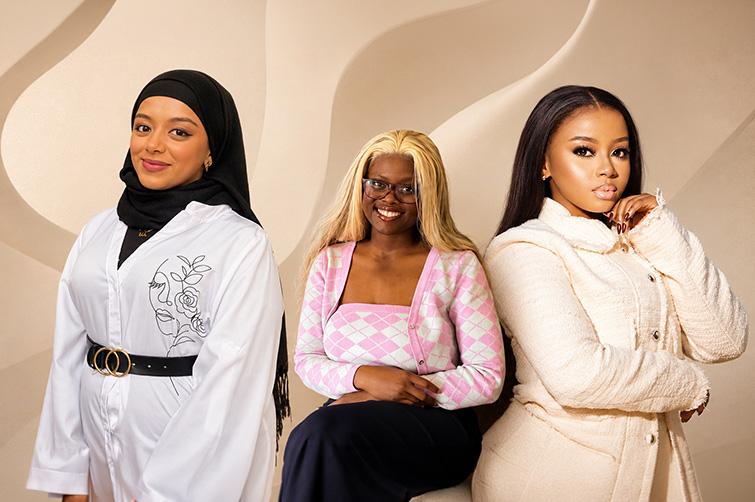 University of the Free State students Bibi Essop, Gugulethu Zwane, and Sibusisiwe Mkhwanazi, three young women who are using their voices, talents, and initiatives to create meaningful impact and inspire others. Their stories reflect this year’s Women’s Month theme, Empowered women empower women.
For some women, empowerment means creating spaces where others feel seen. For others, it means confronting a social challenge or using their own experiences to give someone else the courage to keep going.
At the University of the Free State, three students are demonstrating that empowerment does not have one definition. Through advocacy, entrepreneurship, education, and storytelling, Bibi Essop, Gugulethu Zwane, and Sibusisiwe Mkhwanazi are using their journeys to create opportunities and encouragement for others.
Their stories form part of the university's Women's Month 2026 campaign, Beyond Representation: Empowered Women Empower Women, which looks beyond the positions women occupy to explore the impact they create beyond their formal roles.
For Essop, a student leader and SRC Universal Access portfolio holder, empowerment begins with ensuring that other students can participate fully in university life. Living with a disability has shaped her understanding of what it means to navigate spaces that were not always designed with accessibility in mind.
Through her student leadership, she has advocated for greater inclusion, including diversity reviews in residences, disability-awareness initiatives, and South African Sign Language seminars. Her focus is not simply on being represented in student leadership, but on using that representation to make it easier for others to belong.
“Representation is only the beginning,” Essop says, reflecting on the need to turn visibility into meaningful access and opportunity.
That same principle is evident in Zwane's journey as co-founder and CEO of Eco-Blithe, a youth-led social enterprise addressing period poverty through affordable reusable sanitary pads, menstrual health education, and community outreach.
Along with fellow young women Owami Ngqeleni and Sepeko Moroesi Merabe, Zwane turned an observed social challenge into an opportunity to create change. Her motivation came from seeing girls miss school or struggle to participate fully in everyday life because they could not afford menstrual products.
For Zwane, entrepreneurship has therefore become more than just building a business. It has become a way of restoring dignity and creating opportunities for others.
She hopes her journey will encourage other students to realise that they do not have to wait until graduation or have abundant resources before acting on an idea.
“Leadership is not about titles or recognition – it's about identifying a problem, bringing people together, and having the courage to become part of the solution,” she says.
For Qwaqwa Campus Education student and published author Sibusisiwe Mkhwanazi, empowerment takes another form: using her experiences and her voice to reach young women beyond herself.
Her journey to university was marked by rejection, changing institutions, and financial difficulties before she eventually found her way to the Qwaqwa Campus. Those experiences shaped both the educator she hopes to become and the author she is today.
At 22, Mkhwanazi is the author of Dear Young Girl: Things I Wish My Mother Told Me, a book exploring identity, self-worth, relationships, womanhood, ambition, and the process of becoming.
Writing began as a personal outlet but evolved into something larger. Mkhwanazi wanted to transform experiences of pain, disappointment, and uncertainty into lessons that another young woman could draw from.
“Let my scars become your wisdom,” she says, describing the purpose behind her writing.
For Mkhwanazi, this is what it means to empower women: not simply celebrating them once they have succeeded but helping them while they are still becoming.
“Recommend her. Mentor her. Share her work. Tell her about the opportunity. Give her honest advice,” she says.
The experiences of Essop, Zwane, and Mkhwanazi may be different, but together they reveal the common thread behind Beyond Representation: empowerment becomes meaningful when it extends beyond the individual.
Whether it is creating greater accessibility, addressing period poverty, or turning personal experiences into words that encourage another young woman, these students are using their voices, opportunities, and experiences to create space for others.
And perhaps that is what it truly means to go beyond representation – not simply to occupy a space, but to reach back and make sure someone else knows that there is space for them too.
To close off Women's Month, the University of the Free State continues to celebrate women who are not only becoming, achieving, and leading, but using their journeys to help others become, achieve, and lead too.