20 May 2026
|
Story Dr Nitha Ramnath
|
Photo Kaleidoscope Studios
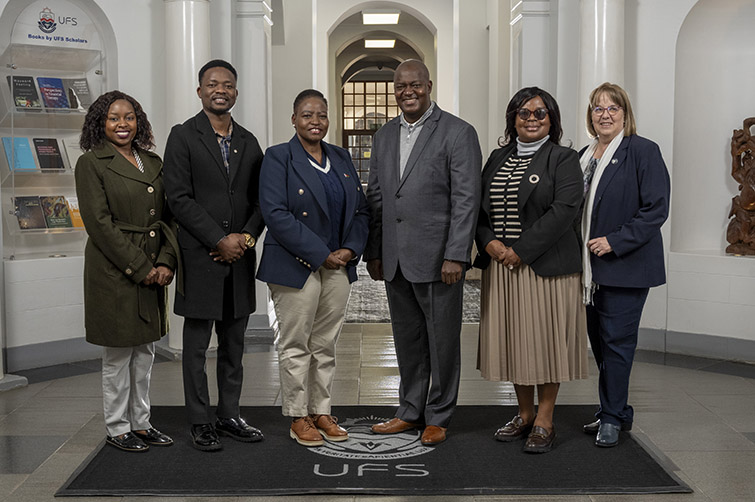 Left to right: Talinda Ulaya, First Secretary: Protocol; Sam Banda, First Secretary: Administration; Her Excellency Stella Chiripo Ndau, High Commissioner of the Republic of Malawi to South Africa, Prof Maashuta Samuel Tshehla, Deputy Vice-Chancellor: Strategic Initiatives, Internationalisation and Institutional Affairs, UFS, Milliam Chikaoneka, First Secretary: Political Affairs, Prof Lynette Jacobs, Acting Director of the Directorate for International Partnerships and Relations, UFS.
The University of the Free State (UFS) welcomed Her Excellency Stella Chiripo Ndau, High Commissioner of the Republic of Malawi to South Africa, for a courtesy visit to the university on 14 May 2026. The visit marked an important step in strengthening academic, research, and institutional relations between the University of the Free State and higher education institutions in Malawi, including the Lilongwe University of Agriculture and Natural Resources (LUANAR).
H.E. Ndau was accompanied by a delegation from the Malawi High Commission comprising Talinda Ulaya, First Secretary: Protocol; Sam Banda, First Secretary: Administration; and Milliam Chikaoneka, First Secretary: Political Affairs. The delegation was received by Prof Maashuta Samuel Tshehla, Deputy Vice-Chancellor: Strategic Initiatives, Internationalisation and Institutional Affairs, and Prof Lynette Jacobs, Acting Director of the Directorate for International Partnerships and Relations at the UFS.
The engagement commenced with a high-level meeting on the Bloemfontein Campus, where discussions centred on opportunities for strategic collaboration, institutional partnerships, research cooperation, and student development initiatives between the UFS and Malawian institutions.
Shared vision for impact and sustainability
Addressing the delegation, Prof Tshehla welcomed the opportunity to deepen ties with Malawi and highlighted the importance of collaboration across the African higher education landscape.
“We value partnerships that are sustainable, impactful, and mutually beneficial. As a university, we are increasingly looking at university-wide partnerships that transcend a single discipline or faculty and instead create broader opportunities for collaboration, capacity building, and innovation,” said Prof Tshehla. “We are exploring modalities and partnership models that could support our Malawian students and our collaboration with institutions in Malawi in a more sustainable and accessible way.”
During the engagement, H.E. Ndau expressed admiration for the university’s strategic direction and institutional impact, noting that she was inspired by the work being undertaken at the UFS.
“It is evident that there is an intentional and thoughtful approach in the way the University of the Free State positions itself, particularly around transforming lives, sustainability, and creating meaningful impact,” said H.E. Ndau. “The Malawi Mission looks forward to continued engagement with the UFS and to specifically visit the Afro-Montane Research Unit on the Qwaqwa Campus, amongst others.”
Expanding opportunities in nursing and health sciences
A key area of discussion focused on the revitalisation and expansion of existing memoranda of understanding (MoUs) between the UFS and Malawian universities, particularly in the fields of medicine and nursing. The delegation explored opportunities for postgraduate collaboration and skills development, especially in response to the growing demand for advanced nursing qualifications among Malawian students.
Prof Jacobs noted that the UFS regularly receives applications from Malawian students interested in pursuing postgraduate nursing studies, but financial limitations often make these opportunities inaccessible. She also highlighted the university’s exploration of digital and virtual learning opportunities aimed at broadening access to postgraduate education.
“We are actively considering virtual and digitally enabled postgraduate programmes that would allow Malawian nurses to further their studies without the significant financial burden associated with relocation and international study,” she said. “Technology creates possibilities for collaboration that are more inclusive and responsive to the realities facing many students on the continent.”
In a significant gesture of collaboration, H.E. Ndau extended an open invitation to the UFS leadership to visit Malawi for the formal signing of a renewed or expanded MoU with LUANAR.
Exploring sustainability and indigenous knowledge collaboration
Beyond health sciences, discussions also explored opportunities for collaboration in sustainability, environmental research, and community engagement. H.E. Ndau expressed particular interest in the work undertaken by the UFS’s Afromontane Research Unit (ARU), especially in relation to mountain ecosystems, sustainability, and deforestation research.
Prof Jacobs emphasised the importance of community-centred approaches to environmental research and sustainability initiatives.
“One of the strengths of the University of the Free State’s approach is the way in which we engage local mountain communities as partners in knowledge creation and solution-making,” she said. “Indigenous knowledge systems and the lived experiences of traditional communities are essential in shaping sustainable responses to environmental challenges.”
Showcasing research and agricultural innovation
Following the formal engagement session, the delegation visited the UFS Centre for Microscopy, where they were introduced to the university’s advanced electron and confocal microscopy facilities during a guided tour facilitated by Edward Lee, Junior Lecturer and Researcher in the Centre for Microscopy, and Prof Jacobs. The visit provided insight into the university’s research infrastructure and scientific capabilities.
The programme continued with agricultural engagements hosted by the Department of Animal Science, led by Prof Errol Cason and Prof Francois Deacon. Prof Cason emphasised the interdisciplinary approach to animal sciences, including animal health and wellbeing, that is taken by the UFS. Of particular importance to the visitors, was the role that Prof Deacon played in in re-establishing a small giraffe population in Malawi following their local extinction. Discussions furthermore focused on agricultural innovation, research collaboration, and opportunities for regional capacity development within the agricultural sector.
The visit concluded with a networking lunch attended by Malawian staff and students studying and working at the UFS, providing an opportunity for further engagement and strengthening people-to-people connections between Malawi and South Africa.
The courtesy visit reflects the UFS’s continued commitment to fostering strategic partnerships that contribute to knowledge exchange, regional development, research excellence, and sustainable impact across the African continent.