07 October 2026
|
Story Lunga Luthuli
|
Photo Kaleidoscope and Blvckhood Family
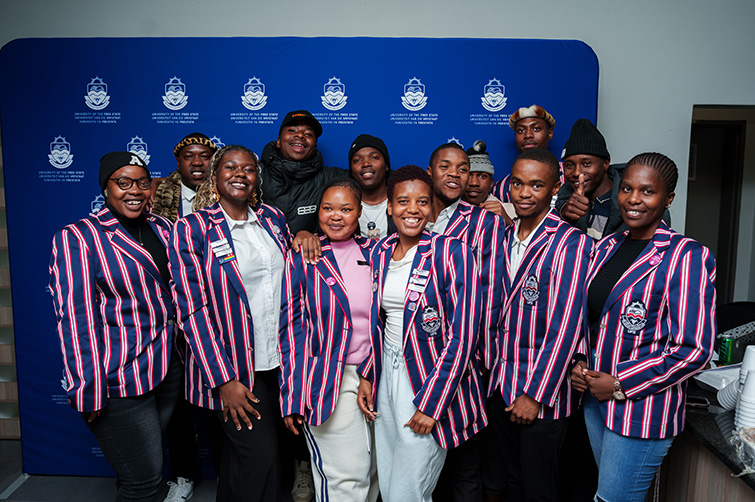 Newly elected student leaders embrace ethical leadership, accountability and service as they prepare to represent their fellow students with integrity.
Newly elected 2026/2027 student leaders from across the University of the Free State’s three campuses have been equipped with key principles and insights to guide them in their leadership responsibilities.
Fresh from being elected, the University of the Free State’s (UFS) 2026/2027 student leaders have begun their leadership journey with a stronger understanding of ethical leadership, institutional governance and the responsibilities that come with representing their fellow students.
The student governance induction programme, hosted by the Student Leadership Development Office in the Division of Student Affairs, Sports, Arts and Culture, brought together the new cohort from all three campuses. The programme provided student leaders with an opportunity to deepen their understanding of student governance and reflect on the principles that should guide them throughout their terms of office.
Building a foundation for ethical leadership
According to
Nothando Hlophe, Acting Assistant Director: Student Leadership Development, the induction was designed to establish a foundation for ethical, accountable and responsible leadership.
“The main objective of the induction was to lay a foundation for the type of student leaders we envision within the institution – leaders who are ethically grounded, accountable, responsible and conscious of the trust placed in them by both the student body and the University,” said Hlophe.
The programme introduced student leaders to the University's governance structures and focused on five key principles: fairness, accountability, responsibility, disclosure and transparency.
While all five principles are important, Hlophe highlighted fairness as particularly significant, following a contribution by UFS Council member
Jerry Thoka.
“Fairness is fundamental because student leaders represent a diverse student body and are expected to serve students impartially and consistently,” she said.
She added that fairness requires leaders to consider inclusion, avoid favouritism and ensure that personal relationships or preferences do not influence their decisions.
For Happy Langa, Qwaqwa Campus SRC President, the induction reinforced the importance of “understanding student leadership as a responsibility grounded in accountability, service and knowing the correct institutional processes.”
Learning from institutional structures
For student leaders, understanding the University’s structures and processes is an important part of effective governance.
Eshly Mabokwane, Prime of House Harmony on the
Bloemfontein Campus, said the Protection Services panel discussion was one of the highlights of the induction.
“The panel discussion opened my eyes to see that there are so many structures that we tend to turn a blind eye to, but these are the structures that are actually there to build up the structure of student governance that we are in,” said Mabokwane.
She said the session helped her understand the role of institutional structures in supporting student governance, while Thoka’s contribution reinforced her understanding of the responsibility that comes with leadership.
Mabokwane said she learned that student leaders must put the interests of those they represent first, while remaining guided by institutional policies and values.
“The biggest lesson or principle that I took with me has to be the one of being unbiased and ensuring that your team capabilities are always embodied by every team member,” she said.
A commitment to serve students
As she begins her term, Mabokwane has committed herself to serving students while upholding both her house values and those of the UFS.
“I hope to be a leader that every student can rely on. Not just students from my house, but all around campus,” she said.
She also expressed her commitment to contributing to the University’s Vision 130 aspirations and its Strategic Plan 2023-2028.
For Vukona Baloyi, Bloemfontein Campus SRC President, the commitment to student service also means recognising that effective leadership is not about solving every challenge alone, but about working collectively and responsibly in the interests of students.
“We may not solve every challenge that students face, but I believe that if we lead ethically, work collectively and remain grounded in the interests of students, we can leave behind a campus that is better organised, more accountable and more responsive than the one we inherited,” said Baloyi.
Baloyi said the approach would also shape the way he intends to lead during his term.
“I want my term to demonstrate that leadership can be exercised with humility and principle, while still being decisive and effective,” he said.
Leadership as a responsibility and service
Hlophe emphasised that the induction is only the beginning of an ongoing leadership development journey.
“We hope student leaders will approach their roles with a stronger understanding that leadership is a responsibility and a form of service, rather than simply a position or status,” she said.
The Student Leadership Development team will continue to support the cohort through ongoing engagement, guidance and leadership development opportunities. These initiatives will help student leaders apply the principles of fairness, accountability, responsibility, disclosure and transparency in their day-to-day roles.
The induction has therefore set the tone for a leadership term centred on ethical conduct, service and accountability – with student leaders encouraged to place the interests of those they represent at the heart of their leadership.