14 October 2026
|
Story Andre Damons
|
Photo Supplied
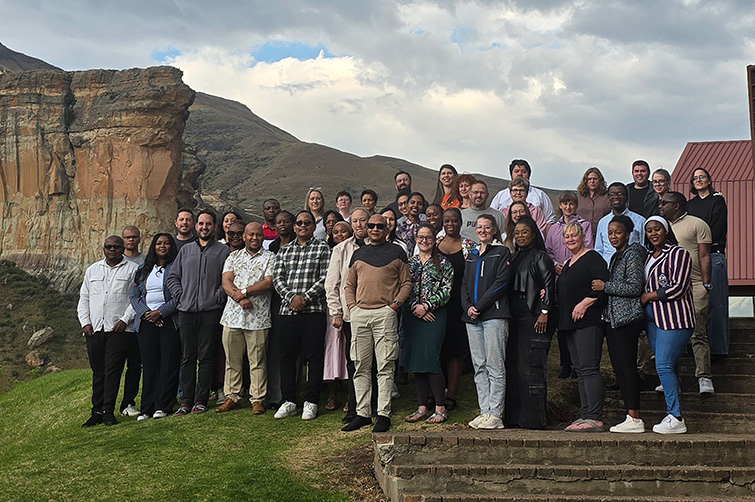 Members from the Transformation of the Professoriate Mentoring Programme, including colleagues from the Emerging Scholar Accelerator Programme and the Future Professoriate groups at the University of the Free State, attend one of the programme’s retreats.
The programme, under the leadership of Dr Henriëtte van den Berg, hosts two weekend retreats a year. The retreats started in June 2022 to increase the engagement between colleagues and between candidates of the programme and members of the University management programme. The latest retreat, and the final one for 2026, took place at the Golden Gate Hotel from 2 to 4 October.
According to Dr Van den Berg, the retreats create an opportunity for members to refine their academic projects, to establish interdisciplinary collaboration and align their research with the University’s strategic goals. It is also an opportunity for colleagues to present their academic project and to reflect on their growth during participation in the programme and continuing to increase the impact of their research and wider societal influence.
Purpose of the retreats
The recent retreat provided an opportunity to celebrate the achievements and excellent performances of members of the Future Professoriate cohort who are now in the final year of their fellowship and planning for important future career milestones. It was also Dr van den Berg’s last retreat in charge of the broader programme.
Prof Vasu Reddy, Deputy Vice-Chancellor: Research, Innovation and Postgraduate Studies, remarked: “Under her stewardship, Dr Henriette has shown that when we create the right space for scholars to connect, collaboration ceases to be an event and becomes a culture. Leadership is not only about guiding people. It is about creating the conditions in which others can thrive. This programme is a powerful example of that vision in action. The greatest research asset of any university is not its infrastructure. It is its people, their ideas, and the relationships that connect them.”
Dr Van Den berg said the retreats are an opportunity for group members to get to know one another and to benefit from the peer support that is a significant factor in the success of mentoring programmes. “Furthermore, the retreats gave colleagues the opportunity to get to know the range of research topics that other colleagues are working on. This creates the opportunity for interfaculty collaboration and for colleagues to work together on articles, funding applications and postgraduate supervision,” said Dr Van den Berg.
She said a large number of attendees are from the Emerging Scholar Accelerator Programme (ESAP) and the Future Professoriate groups. Over the years, the involvement of members of the University management played a critical role in helping colleagues to understand university management processes better, and to feel that they are supported by management.
Benefits of the retreats
The main outcomes of the retreats included the feedback members get from a diverse audience on how to improve the focus and conceptualisation of their research ideas, how to improve the impact and grow their network of international collaborators. The supportive environment at the retreat also plays a significant role in helping to develop the confidence of young scholars.
“The opportunities for cross-faculty collaboration are limited by staff members’ lack of knowledge of the research done by colleagues in neighbouring departments and other faculties. The most important benefit is to understand who is working in related fields and to target colleagues that can work with them on specific projects.
“Researchers are often so busy with their daily academic tasks that there is little time to socialise with colleagues, talk about the trials and tribulations of academic careers, that the relaxed environment in Golden Gate helped us to build a supportive ecosystem for colleagues in the programme, they learn from one another, encourage and support each other and often become critical partners in their research journeys. They go away from the retreat feeling more motivated and believing it is possible to achieve their goals,” said Dr Van den Berg.
Focus of the programme
On her years as head of the programme, Dr Van den Berg said she feels privileged to have worked with exceptional young academics with remarkable skills and dedication to advance their disciplines to the benefit of society. Academic careers can be demanding and the continuous pressure on academic staff to perform at exceptional levels to achieve the strategic goals of the University and to advance their careers can be overwhelming. The mentoring programme focuses on personalised support, creating a sense of belonging though cross-faculty communities of practice and growing the sense of mastery of colleagues as they gain confidence and achieve success within the complex higher education workspace.
Dr Van den Berg said: “In the mentoring programme we prioritised the person and not just the researcher or academic. An important determinant of the success of the programme is the ongoing efforts to understand how best to assist each member of the group to ensure that they successfully navigate their careers and collectively build an enabling research ecosystem amongst group members to enhance their performance. I look back at the seven years of building and refining the programme with immense satisfaction and gratitude for the contribution that I could make to the career journeys of the members of the programme.”
According to Prof Reddy, every emerging scholar carries the potential to redefine knowledge, challenge convention, and shape more inclusive, sustainable and responsible societal futures. “Mentorship is more than guidance. It is the act of opening doors, creating opportunities, and ensuring that talent can flourish without limits. As we cultivate the next generation of researchers, we are not simply building careers. We are building the intellectual foundations of tomorrow's society,” he observed.