07 September 2026
|
Story Andre Damons
|
Photo Sizwe Gwiba and Andre Damons
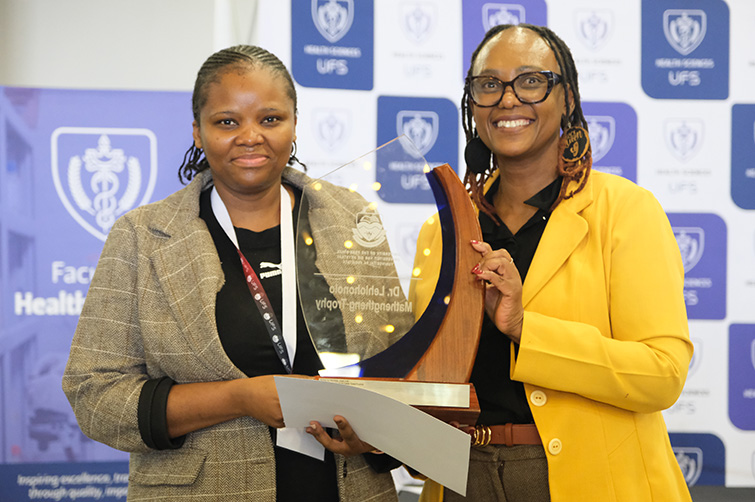 Zothile Skosana from the Department of Medical Microbiology received the Dr Lehlohonolo Mathengtheng floating trophy
The Faculty of Health Sciences at the University of the Free State (UFS) recently crowned its best staff and student researchers for the past year during its annual Faculty Research Forum – a platform that showcases the high-quality research being conducted in the faculty.
Building on the success of previous years, the 57th Faculty of Health Sciences Research Forum, held on 27-28 August once again delivered high-quality clinical, laboratory and educational oral and poster presentations. On the last day, medals, trophies, and certificates were handed out to winners in the different categories.
The 31st FP Retief Lecture, titled “Beyond the AI hype – challenges facing health professional education” was delivered by Prof Jennifer Chipps, an Emeritus Professor at the University of the Western Cape (UWC) and the DSTI/NRF Decadal Plan Aligned SARChI Research Chair in Digital Health.
John van der Riet Medal Winners
Willem Boonzaier, Junior Lecturer and Medical Physicist in the Department of Medical Physics, and his colleague, Lourens Strauss, are the John van der Riet Medal winners. In 2025, they also won the prize for the best clinical presentation from a junior staff member for this work, which motivated them to publish their methods.
“Winning this award is an honour. To have our team's research acknowledged internally brings not only gratitude, but also motivation to keep working toward our goals,” said Boonzaier,
“Our research is about showing that with custom-built smart AI tools, we can cut down on time spent planning prostate cancer radiotherapy treatments without compromising on quality. It explores the idea of using either simple mathematical approximations or simple rule-based approaches controlled by a computer to predict what a prostate cancer radiotherapy plan should look like, based only on how the patient’s organs are arranged around the tumour.
“It then makes a quick initial prediction for a radiotherapy plan that can be scrutinised by a medical physicist to verify or correct before completing the plan. Our research shows that these methods can help save up to seven hours of planning time per patient for up to 70% of patients receiving prostate cancer radiotherapy at Universitas Academic Hospital Annex, without compromising treatment quality,” they explained.
They found that when this AI tool is used in collaboration with the skills of the medical physicist responsible for the planning, they can produce a more consistent stream of high-quality plans among many planners, reducing inter-planner variability. While they started implementing this locally, the researchers hope it demonstrates that simple mathematics or functions can solve complex problems in resource-constrained environments if applied safely and ethically. They hope to inspire other African colleagues in resource-constrained settings to claim ownership of their environment and make the most of what is available.
SAMA Medal
Dr Corlia Kamffer, together with colleagues Dr Hilge du Preez and Prof Jacques Janse van Rensburg from the Department of Clinical Imaging Sciences, won the SAMA Medal for their research paper “Risk factors associated with the outcomes of fluoroscopy guided pneumatic enema reductions of intussusceptions”.
“It is truly an honour to receive this award. I’m incredibly grateful and humbled by the recognition. It’s the first award of its kind for me, although I was also very fortunate to receive the Best Radiological Society of South Africa (RSSA) SASPI Conference Poster Presentation Award in November 2025. I’m incredibly grateful for both recognitions,” she said.
According to Dr Kamffer, the research highlights the important role of ultrasound and early recognition of intussusception, particularly in a South African/resource-limited setting. Identifying children at higher risk of failed reduction can help clinicians make earlier, better-informed decisions and potentially reduce unnecessary surgery, hospitalisation and pressure on surgical services.
“My hope for this research is that it contributes to better recognition and management of paediatric intussusception, particularly by helping identify patients who may be at higher risk of failed pneumatic reduction.
“Ultimately, I hope it supports timely decision-making, encourages appropriate use of non-surgical reduction, and contributes to improved outcomes for children. Most importantly, I hope the research adds something meaningful to our local radiology department and can benefit patients in the future,” said Dr Kamffer.
Muller Potgieter Medal
For Prof Martin Nyaga from the UFS – Next Generation Sequencing (UFS-NGS) Unit, winning the Muller Potgieter Medal is a great honour and recognition for a sustained body of genomic research on rotavirus undertaken through the UFS-NGS Unit and its national and international collaborators. Other researchers part of the winning team, include Nkosazana D Shange, Milton T Mogotsi, Ayodeji E Ogunbayo, Nicola Page, Hlengiwe Sondlane, Matthew D Esona, Benjamin Kumwenda, Chimwemwe Mhango, Flywell Kawonga, Ernest Matambo, Samuel NK Mingle, Francis E Dennis, Jere C Khuzwayo, Nigel A Makoah and Celeste M Donato.
The work forms part of the multi-country Sequencing of the Antigenic Cartography of Enteric Viruses (SACEV) project, funded by the Gates Foundation, involving researchers from South Africa, Malawi, Ghana and Kenya, of which Prof Nyaga is one of the Co-Principal Investigators.
“I am particularly pleased that this research has been recognised because it reflects the collective efforts of a multidisciplinary team and demonstrates how large collaborative research programmes can generate impactful scientific outputs while contributing to postgraduate training and capacity development,” he said.
According to Prof Nyaga, their research focuses on understanding the genetic diversity, evolution and epidemiology of viruses that cause diarrhoeal disease, particularly rotavirus, using whole-genome sequencing and genomic approaches. Rather than examining only a small part of the virus, whole-genome sequencing allows them to study the broader genetic makeup of circulating strains. This helps to identify different viral lineages, understand how they change over time and investigate their relationships across populations and geographical regions.
“My hope is that this research will contribute to strengthening genomic surveillance of viral diseases in South Africa and across Africa. We need to continue building local capacity to generate and interpret genomic data so that African researchers can better understand pathogens affecting our populations and contribute directly to global scientific knowledge.
“I also hope that this work demonstrates the value of sustained investment in research infrastructure, postgraduate training and collaborative research networks. When these elements come together, they allow us to address important public-health questions while developing the next generation of scientists. Ultimately, I hope this research contributes to stronger surveillance, better understanding of viral evolution and improved preparedness for infectious disease threats in South Africa and across the continent,” Prof Nyaga said.
Other winners are:
Kerneels Nel Medal Winner: Dr Nashua Naicker and A Munsamy, Division of Health Sciences Education, Office of the Dean.
“Pedagogical strategies for specialised coursework postgraduate programmes in optometry: a mixed methods study for South Africa.”
Dr Lehlohonolo Mathengtheng floating trophy: Zothile Skosana, Department of Medical Microbiology.
“DNA from Used Xpert Mtb/Rif ultra cartridges obtained using the Credo extraction device reduces drug-resistant Tuberculosis care cascade gaps in a routine laboratory.”