08 September 2026
|
Story Leonie Bolleurs
|
Photo Kaleidoscope
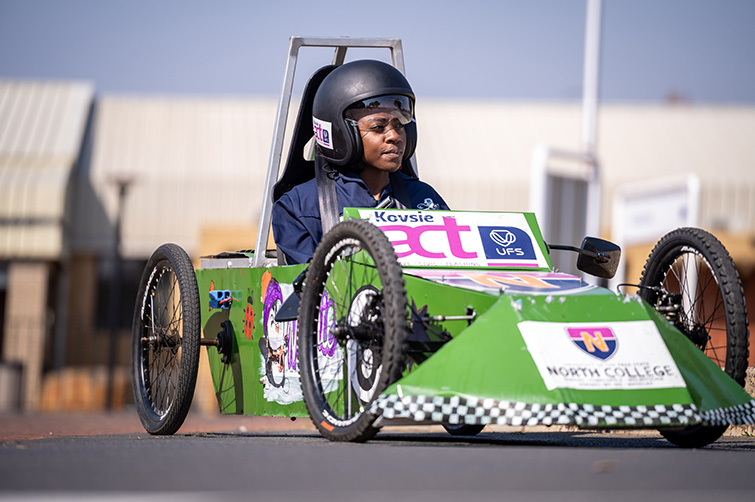 North College celebrates its victory in the final 1.0 Kovsie ACT Eco-Vehicle Race, marking the end of an era for the original race vehicles.
The roar of the vehicles on race day is only one part of
the Kovsie ACT Eco-Vehicle Race. For the students taking part, the competition marks the culmination of nine months spent learning how to build, programme, and test electric vehicles, while developing the teamwork and problem-solving skills needed to get them across the finish line.
After last year’s victory by the Central University of Technology (CUT), the overall 2.0 Kovsie ACT Eco-Vehicle Race title went to Nelson Mandela University (NMU) this year. The UFS Qwaqwa Campus finished in second place, with the Vaal University of Technology (VUT) taking third.
The 2.0 off-road race brought teams from the UFS, CUT, VUT, and NMU together for a series of challenges that tested the vehicles and the students behind them. CUT won the Smart Lap, while CUT and the UFS Bloemfontein Campus shared the winning title for the Pit Stop Challenge. CUT won the Bluetooth race, and NMU claimed the Endurance race.
Building skills beyond the classroom
For
Teddy Sibiya, Project Coordinator of the Kovsie ACT Eco-Vehicle Race, the results are only part of what makes the programme worthwhile. “One of my biggest highlights over the years is watching the students grow,” he says.
Students who may begin the programme knowing little about electric vehicles are given the opportunity to learn how to build one, understand its components and work together as a team.
This learning takes place over nine months through the Eco-Vehicle Sustainable Skills Programme. Students progress from building a small-scale car and solar charging station to programming vehicles and constructing larger race cars fitted with battery packs and solar panels. Race day provides an opportunity to put those skills into practice.
René Pelser, Acting Director for Student Life, describes the race as one of
Kovsie ACT’s flagship co-curricular programmes because of the training and development it provides outside the classroom. Students gain practical experience while developing skills that complement their formal academic learning.
Dr Temba Hlasho, Executive Director of
Student Affairs, believes the initiative has the potential to reach even more students. He hopes the race can grow into a sector-wide event that brings more South African universities into the programme and expands access to the skills and opportunities it provides.
This year also marked the final race for the 1.0 vehicles, bringing that chapter of the Eco-Vehicle Race to a close. The UFS’ North College claimed the overall title, followed by East College in second place and Central College in third.
North College also won the Smart Lap, while Central College claimed the Spirit Cup. South Campus won the Bluetooth race, and South College took the Endurance race. Central College and East College shared the Pit Stop Challenge title.
The students remain at the centre of the programme – from those who build and prepare the vehicles to those who line the track to support their peers. Their involvement gives the event its energy, while a network of partners helps to make the programme possible. These include the Department of Agriculture, Rural Development and Environmental Affairs, UFS management, CUT, VUT, NMU, the University of South Africa, SA Truck Bodies, Diedericks Race Cars, MiiRobotics, RS Components, and Heroldts.
According to
Karen Scheepers, Head of Kovsie ACT, this year’s race was a big success. Beyond the trophies and race results, the programme gives students the opportunity to develop practical skills in a setting where they have to build, test, troubleshoot, and try again.
The vehicles may have crossed the finish line, but the learning continues. Through months of building, programming, and problem-solving, students gain practical experience and the confidence to tackle challenges, work through setbacks, and find solutions. As the programme looks to bring more universities into the race, those skills could reach an even wider group of students.