29 September 2026
|
Story Siqhamo Hlubi Jama
|
Photo Sibahle Dayimani
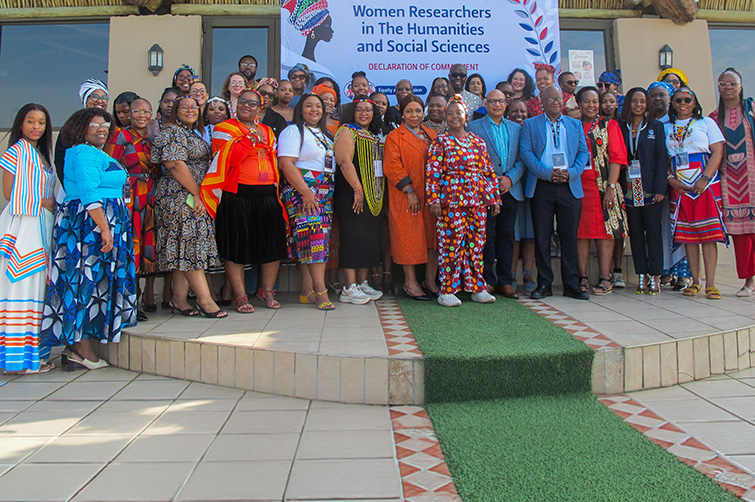 Women researchers and delegates at the third Women Researchers in The Humanities and Social Sciences Conference, hosted by the University of the Free State from 21 to 23 September 2026, under the theme Critical Lactation Politics: Re phahamisa ba bang re ntse re nyoloha, or Lifting as we climb.
Progress, when it is meaningful, is not measured only by how far one woman climbs. It is also measured by whether her journey creates a pathway for others.
This was the idea at the heart of the third Women Researchers in The Humanities and Social Sciences (WoRiTH) Conference, hosted by the University of the Free State. Held under the theme Critical Lactation Politics: Re phahamisa ba bang re ntse re nyoloha, or Lifting as we climb, the three-day conference brought together women scholars from the University of the Free State, the University of Zululand, and the National University of Lesotho to interrogate women’s experiences, agency, and leadership in higher education.
The conference continued the conversation established at the inaugural
2025 WoRiHSS conference at the University of Zululand, placing particular emphasis on solidarity, feminist and womanist mentorship, collaboration, and the barriers that continue to shape women’s academic trajectories.
In his opening remarks, Professor Vasu Reddy, Deputy Vice-Chancellor: Research, Innovation and Postgraduate Studies, said: “What makes this event special is that it is not only about research. It is about people, growth, and solidarity. The focus on addressing lactation politics is important and courageous because it reflects a human experience, a lived reality that is central to the academic and knowledge project. A university fulfils its public good aspirations when we expand, recognise, and care about who gets to belong, who gets to lead, and whose knowledge counts. Advancing women and gender equity is therefore not peripheral to the university; it is central to it.”
From individual journeys to collective power
Prof ‘Mabokang Monnapula-Mapesela, Deputy Vice-Chancellor: Academic and Student Affairs at Rhodes University, set the tone with a keynote address that drew deeply on her own academic and leadership journey.
Reflecting on her experiences as a black woman in higher education, Prof Monnapula-Mapesela described women’s stories and voices as ‘our untapped power’. Every woman, she observed, carries a story from which both younger and older generations can learn.
Her reflection was deliberately grounded in academic experience rather than presented simply as a personal account. Academic journeys, she explained, are rarely smooth or linear. They are layered, complex, and shaped by opportunities, choices, and the intentional use of available resources.
For Prof Monnapula-Mapesela, sharing those experiences is therefore also an act of creating possibilities for others. Women must consider not only how they navigate their own journeys, but how they can use their agency to create pathways for those who follow.
Mentorship as a way of lifting
That principle ran through the conference’s broader programme, where mentorship emerged not as an optional addition to academic development, but as a way of building collective capacity.
Dr Florence Tadi explored black women mentoring black women through postgraduate supervision in an African university. At the same time, Dr Theresia Kanyopa and Dr Gwendolyn Davids examined academic collaboration through mentorship among women in South African higher education institutions.
Dr Mpho Ramarumo considered collective efficacy and shared resilience as an antidote to isolation and imposter syndrome. Dr Tebello Mduduma and Dr La-Toya Stone examined resilience, well-being, and empowerment amid the multiple demands placed on women’s lives.
Together, these contributions reframed academic advancement as something that can be shared. Success becomes more consequential when experience, knowledge, and confidence are passed on.
Reimagining women’s leadership
Leadership was another central concern, with scholars examining the structures and assumptions that continue to shape women’s participation in academic power.
Prof Allucia Nkosi-Shokane, Dean of Humanities and Social Sciences at the University of Zululand, opened the keynote programme with Climbing the Academic Ladder in Heels: The Politics of Gender, Care, and Intellectual Power in Academia.
Her keynote was followed on the final day by Prof Zethu Nkosi, Executive Dean of the College of Human Sciences at the University of South Africa, whose address, The Ripple Effect: How Mentorship Shapes Futures, returned to the long-term influence that one academic can have on another.
University of the Free State researchers extended these questions through work on academic development, leadership, gender inequality, institutional representation, cultural expectations, and resilience.
Dr Rosaline Sebolao examined four years of the Faculty Excellence Awards as an academic development strategy. At the same time, Prof Nomalungelo Ngubane reflected on black women’s experiences of transitioning into leadership through an autoethnographic account.
A future built together
The phrase Re phahamisa ba bang re ntse re nyoloha captures the conference’s central proposition. Advancement need not be a solitary climb.
“Gender-inclusive leadership is not simply about representation. It is about transforming how power is exercised, how opportunities are created, and how future generations of scholars are nurtured. A truly inclusive university is one where women do not have to choose between caregiving and achievement. As we co-build responsible societal futures, let us ensure that every step forward creates space for others to advance alongside us,” remarked Prof Reddy
For the University of the Free State, WoRiTH reflects a commitment to responsible societal futures through scholarship that interrogates inequality while creating spaces for mentorship, collaboration, and collective growth.
The conference ultimately asks a question that extends beyond individual academic achievement – what becomes possible when those who have climbed create room for others to rise?