10 September 2026
|
Story Siqhamo Hlubi Jama
|
Photo Supplied
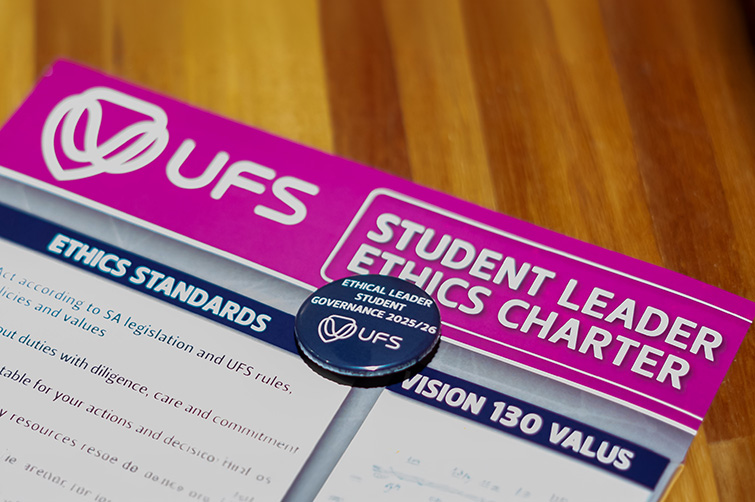 The UFS Student Leader Ethics Charter promotes integrity, accountability, and ethical leadership among student governance structures across the university.
Leadership is not only about holding a position. It is also about the choices leaders make when representing others, managing responsibilities, and navigating difficult decisions.
Recognising the influence that student leaders have on campus culture, the University of the Free State has introduced a comprehensive Student Leader Ethics Charter to strengthen ethical leadership, accountability, and integrity across student governance structures.
Developed through a collaborative process led by the
Division of Student Affairs Student Leadership Development Office, the charter provides a values-based framework that guides ethical conduct and decision-making among student leaders. It aligns with the university's commitment to excellence, accountability, care, social justice, innovation and sustainability, while supporting the broader vision of the University to contribute meaningfully to
responsible societal futures.
The charter was first introduced during the induction of newly elected student leaders in September 2025, when it was presented to Student Representative Council and Residence Council members from the Bloemfontein, South, and Qwaqwa Campuses. Student leaders welcomed the initiative but also called for a more consultative process that would allow them to contribute to the development of the final document. Their feedback became a key catalyst for the extensive engagement process that followed.
A charter shaped through consultation
In response to student feedback, the
Student Leadership Development Office embarked on a consultation journey throughout 2026 to ensure broad participation from student governance structures and organisations. The ethics charter was reintroduced during association and organisation leadership training in March 2026, where student leaders from across campuses were encouraged to engage with the document and prepare for formal consultation processes.
According to
Nothando Hlophe, Assistant Director for Student Leadership Development, a dedicated review team comprising representatives from Student Affairs coordinated the consultation process. This included a virtual engagement session held in April 2026, followed by an open consultation period that enabled student leaders to review, discuss, and submit recommendations on behalf of their respective structures.
Hlophe added, “The final review process considered the submissions received from student governance structures, resulting in a refined charter that balances institutional values with student perspectives. The outcome is a practical guide that promotes ethical leadership as a daily practice rather than merely a compliance requirement.”
Embedding ethics into student leadership
The charter applies to all student governance and co-governance structures, including the Institutional Student Representative Council, Campus Student Representative Councils, Faculty Student Councils, residence committees, associations and organisations, as well as student parliamentary and judicial structures.
To support implementation, the charter is accompanied by several developmental initiatives, including ethics induction programmes, round-table discussions, peer accountability systems, practical ethics resources, and continued guidance from Student Affairs staff. These measures are designed to create meaningful opportunities for reflection, learning, and ethical leadership development throughout students' leadership journeys.
By promoting ethical awareness and responsible leadership, the UFS Student Leader Ethics Charter seeks to strengthen trust within student governance structures and contribute to a campus culture grounded in integrity and accountability. Ultimately, the initiative reflects the university's belief that ethical leadership is essential to developing graduates who will make meaningful, sustainable contributions to society.