Latest News Archive

Please select Category, Year, and then Month to display items
Previous Archive
06 September 2023 | Story André Damons | Photo Supplied
radiation dose distribution
The patient is still under anaesthesia, the placement of the brachytherapy applicators is completed, and they are connected to the Iridium source for the radiation to be given.

Medical personnel at the Universitas Academic Hospital and the University of the Free State (UFS) in Bloemfontein became the first in Southern Africa to use Interstitial brachytherapy as a method for treating cervical cancer. 

A multidisciplinary team, consisting of an anaesthetist, clinical oncologists, application specialists, medical physicists, radiation therapy radiographers and professional nurses, completed the first interstitial cervical cancer brachytherapy in Southern Africa at Universitas Academic Complex in June this year.

Prof Alicia Sherriff, Head of the UFS Department of Oncology and a clinical oncologist, explained: “Brachytherapy is a method of internal radiation therapy, where a source of radiation is placed inside or near the cancer. This type of radiation travels only a short distance and makes it possible to deliver curative doses to the cancer while staying within the tolerance of the surrounding bladder, rectum, and small bowel.” 

She further emphasised that intracavitary brachytherapy has been an essential component of the curative management of cervical cancer since 1938.

According to her, feasibility studies were published for the use of applicators that combine intracavitary and interstitial brachytherapy in 2006. In 2014 prospective clinical trials started reflecting on the clinical value to improve local control for the locally advanced cervical cancers with combining intracavitary and interstitial brachytherapy to get higher doses of radiation where the cancer has grown outside of the cervix. Interstitial brachytherapy where the applicators are placed into the tissue with cancer are also used in prostate and breast cancer. 

Second-most common cancer in South African women

As per the Catalan Institute of Oncology (ICO) and the International Agency for Research on Cancer (IARC) information Centre on Human Papilloma Virus and cancer publication of March 2023, the current new diagnoses of cervical cancer annually in South Africa are 10,702 with 5,870 patients passing away annually due to cervical cancer. It is the second-most common cancer in women in South Africa and the most common among women between 15 and 44. Due to late/delayed presentation and diagnoses most cervical cancer patients seen have more advanced stages where the cancer has infiltrated outside of the cervix into the surrounding tissue.

“At the Universitas Academic Complex we have been approaching cervical brachytherapy with CT (Computer Tomography)-based image guidance for more than a decade already and the past five years we have been doing Adaptive CT-based image guided brachytherapy. 

“This means that with each brachytherapy treatment the cancer and all the surrounding normal organs are delineated based on a new CT image to ensure that we consider how the cancer has shrunk from one brachytherapy to the next and to see how we can limit the dose to the surrounding organs but at the same time achieve the highest possible dose of radiation with each treatment,” says Prof Sherriff. 

Planning to expand the use to other cancers

The intracavitary brachytherapy applicators which are used most frequently are placed within the cervix and uterus and deliver high doses there but cannot address the infiltration into the surrounding tissue adequately, she continued. “That is where these additional needles that are placed via the Venezia applicator into the surrounding tissue give the ability to also reach those areas with high-dose radiation while sparing the organs.”

Prof Sherriff explained that the interstitial brachytherapy does add additional time, expertise and logistical planning to the management and would not be utilised for all cervical cancer patients, but for those patients with locally advanced disease whose general health would support a more aggressive approach. The other academic training institutions are aiming to add interstitial brachytherapy to their platforms as well as at the UFS which is also planning to expand the use to other cancers. 

Save more lives

The MEC for Health in the Free State province, Mathabo Leeto, has congratulated medical professionals on this groundbreaking medical intervention. 

She said this breakthrough is in line with goals set by the United Nations in not only the provision of quality health services, but also and importantly, saving lives.

“This milestone is responsive to our targets for improvement of women’s health and reducing mortality. It is responsive also to Goal 3 of the United Nations’ Sustainable Development Goals which seeks to reduce global maternal mortality ratio, ensure universal access to sexual and reproductive health-care services, including for family planning, information and education, and the integration of reproductive health into national strategies and programmes,” she said.

“Hopefully this breakthrough will help us save many more lives. I wish to congratulate everyone who contributed to this innovative way of cancer treatment and assure you that your province and the people are indebted to you,” concluded Leeto.
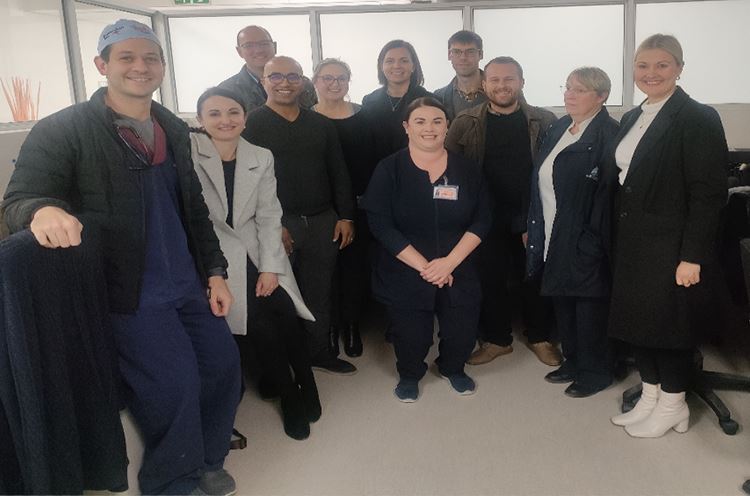


The medical staff who were involved in the first interstitial cervical cancer brachytherapy in Southern Africa were, from left: Dr Marnus Booyens (Anaesthetist); Dr Karin Vorster (Head Clinical unit and Clinical Oncologist); Dr Willie Shaw (Head of Medical Physics for the division of Radiation Oncology); Khalil Ben Fredj (Application Specialist ELEKTA for the TIMEA region and medical physicist); Prof Alicia Sherriff (HOD Oncology and clinical oncologist); Dr Dedri O’Reilly(medical physicist); Chantel Stroebel (Radiation therapy radiographer at brachytherapy); Dr Lourens Strauss (Medical physicist); Karl Sachse (Medical physicist); Sr Angelique Engelbrecht (professional nurse); Marga Claassen (Clinical and Commercial Account Specialist, SA for Elekta and Medical physicist).

News Archive

UFS responds to concerns around high costs of higher education
2015-10-15


Dear Students

UFS responds to concerns around high costs of higher education

There is an understandable and shared concern among students in the country around the high costs of higher education. As you know, this also is a matter of deep concern on our campuses, which the University of the Free State (UFS) has made a priority in discussions with student leaders - and through new strategies to relieve the burden of costs on poor students and their families. In fact, in the past two weeks, the UFS leadership has again engaged students on the matter of fees in the future.

This is what we have done so far. We have maintained our position as one of the universities with the lowest tuition fees in the country. As you would have seen from recent newspaper reports on the cost of a degree at various institutions over the past five years, the UFS has had consistently low fees. This is not an accident; both the University Council and the executive leadership of the UFS is of one mind that we must offer a high quality education at minimum cost to all our students, despite the rising costs of operating a large multi-campus university with 30 000 students. Our commitment to you is to continue to keep those costs to students as low as possible, without compromising on the quality of education.

In addition, we took a decision earlier this year to become the first university to drop application fees for first-year students. We are proud of that achievement, since so many students fall at this first hurdle as they contemplate post-school education and training. We also waived registration fees for postgraduate students and now Research Master’s and PhD students can study tuition free under certain conditions. We raised more than R60 million from the private sector to enable talented students, who do not receive NSFAS funding, to complete their degree studies at the UFS. We set aside some of the university’s own funds to enable even more students to access finance for their studies. And we now have a special office set aside to counsel and assist students to apply for more than one scholarship to support their studies. The university does not follow a policy of maximizing exclusions. It has endeavoured and succeeded to turn around the majority of its potential deregistration cases. During 2015 we had 2 700 students at the risk of being de-registered, but our serious efforts resulted in only over 200 instances of exclusion we could not mitigate. As is the practice for the past few years, these students’ debt for 2015 has been reversed.

But, we do not only look for funds from outside to support our students. Last year we set up a Staff Fund to which ordinary members of the academic and support staff can contribute from their own, and sometimes very modest, salaries to enable Kovsie students to finish their degrees. We have volunteers who work on the No Student Hungry (NSH) Bursary Programme to raise funds for students who cannot afford a regular meal. We have an open line to rural and township schools to nominate poor students with good results for support by the Rector’s Fund, and some of those students are now in their final year of studies. And many of our staff support individual students in their homes and with their families, without being asked to do so. This is what we call the Human Project and it remains central to the way in which we deal with students.

We will of course continue to make representation to government, the private sector, and individuals to increase funding, especially for first-generation students, and for families where more than one student is at university. We will continue to take to the road to raise funds from companies and foundations to finance our students. We will expand on-campus opportunities for limited working hours for students who wish to earn some money to support their studies. As we have said often before, no student who passes all their courses or modules will be turned away simply because they do not have the funds to study.

The UFS discusses and agrees to fee increases with our students well in advance of the next academic year. None of these decisions are taken without the agreement of the student leadership and thus far these engagements, while tough, have always been done in good faith and with the students’ interests at heart.

It is important for you to know that, with the declining government subsidy, in real terms, and the expanding needs of our students, we will not be able to keep the university running without fees - even though this source of revenue comes mainly through scholarships and bursaries. We need to compensate staff, purchase new library books and renew journal subscriptions (which is very difficult given the low value of the Rand), upgrade computers and software, pay rates and taxes, purchase laboratory equipment, pay the water and electricity bills, expand internet services, upgrade campus security, and hire more academics to keep class sizes reasonably small. It is important for you to know that the university has managed to avoid increasing student fees as a result of much higher municipal rates. Our lecturers are not the highest paid in the country and financially we run a tight ship. We consistently achieve unqualified audits and we are known to be one of the universities that manage its NSFAS contributions with great efficiency. We do this because of our commitment to ensure that our students are able to enjoy a high quality of education on a stable campus where there is a deep respect for all campus citizens.

Despite all these efforts, the most important message we wish to communicate, is that the door remains open for continued discussion with student leaders as we continue to find ways of keeping university education open and accessible to all qualifying students. At the same time, the UFS leadership is involved in discussions with government about how to best manage the escalating cost of higher education for our dents.

Thank you for your support and understanding at this time and be assured, once again, of our commitment to students as a matter of priority to the university leadership.

Best regards

Prof Jonathan Jansen
Vice-Chancellor and Rector

University of the Free State
19 October 2015

We use cookies to make interactions with our websites and services easy and meaningful. To better understand how they are used, read more about the UFS cookie policy. By continuing to use this site you are giving us your consent to do this.

Accept