Latest News Archive
Please select Category, Year, and then Month to display items
03 September 2026
|
Story Nthabeleng Seleteng
|
Photo Nthabeleng Seleteng
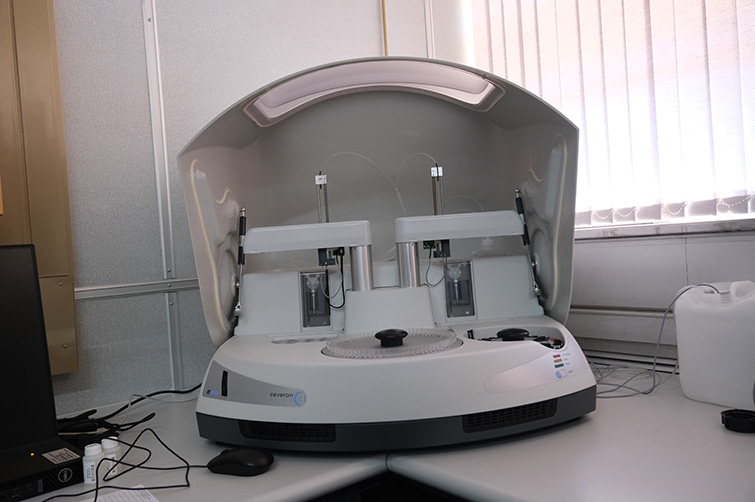
![DSCF6067[1]](https://www.ufs.ac.za/images/default-source/news-images/dscf6067-1.jpg?sfvrsn=241dcb20_1 "DSCF6067[1]") The UFS Special Haemostasis Laboratory acquired the Ceveron s100 Technoclone Instrument, in partnership with Novo Nordisk Haemophilia Foundation through the South African Haemophilia Foundation. Colleagues in the Department of Haematology and Cell Biology who will be working with the new Ceveron s100 Technoclone instrument are: Rethabile Maleka, Medical Scientist; Charmainé Conradie, Medical Technologist and Chief Officer; Prof Muriel Meiring, Principal Medical Scientist; Prof Jaco Joubert, Head of the Department of Haematology and Cell Biology; and Dr Leriska Haupt, Principal Pathologist.
The UFS Special Haemostasis Laboratory acquired the Ceveron s100 Technoclone Instrument, in partnership with Novo Nordisk Haemophilia Foundation through the South African Haemophilia Foundation. Colleagues in the Department of Haematology and Cell Biology who will be working with the new Ceveron s100 Technoclone instrument are: Rethabile Maleka, Medical Scientist; Charmainé Conradie, Medical Technologist and Chief Officer; Prof Muriel Meiring, Principal Medical Scientist; Prof Jaco Joubert, Head of the Department of Haematology and Cell Biology; and Dr Leriska Haupt, Principal Pathologist.
The acquisition of the Ceveron s100 Technoclone Instrument, a fully automated laboratory analyser, will not only strengthen the University of the Free State (UFS) Special Haemostasis Laboratory’s (SHL) national diagnostic capacity for bleeding and thrombotic disorders, but will also improve patient care and reducing hospital stays.
This laboratory, a National Reference Laboratory handling complex haemostasis testing for South Africa and neighbouring countries, recently purchased this R1 133 701.17 instrument through joint funding between the UFS and the Novo Nordisk Haemophilia & Haemoglobinopathies Foundation (NNHF) with the assistance of the South African Haemophilia Foundation (SAHF). It processes specimens from both private and publicly funded healthcare facilities, and for certain tests (such as the VWF multimer analysis, collagen-binding assay, ADAMTS13 levels and autoantibody assays). It is the only facility currently performing these tests in the state sector for the entire Southern African region.
Significance of Ceveron s100 Technoclone
According to Prof Muriel Meiring, Principal Scientist in the UFS Department of Haematology and Cell Biology which hosts the haemostasis laboratory, the instrument is a fully automated laboratory analyser used for blood clotting (haemostasis) tests. “It can perform a wide range of advanced coagulation tests, including clotting, chromogenic, and turbidimetric assays with an advanced thrombin generation assay (TGA) and fluorescent quenching technologies. This instrument replaces many manual testing methods, allowing tests to be completed faster, more accurately, and with less hands-on labour.”
Prof Vasu Reddy, Deputy Vice-Chancellor: Research, Innovation and Postgraduate Studies remarks: “I congratulate Prof Muriel Meiring and the Special Haemostasis Laboratory team on advancing a nationally significant diagnostic capability. The acquisition of this cutting-edge technology demonstrates our commitment as the University of the Free State to research that serves society and responds to real-world challenges. Research infrastructure matters because every innovation that shortens diagnosis can improve lives and strengthen healthcare systems.”
This instrument has been integrated into the SHL’s specialised coagulation diagnostic workflow, which processes specimens from public hospitals and private healthcare facilities across all regions in Southern Africa. The instrument will be used in a high-volume, specialised diagnostic environment where complex haemostasis assays are routinely referred for expert testing. Automation will replace manual assay workflows currently requiring two to three weeks to complete.
“The acquisition of this instrument will strengthen our national diagnostic capacity for bleeding and thrombotic disorders, support clinical care, research, and training, thereby advancing the department’s academic mission. It will enabling the Special Haemostasis Laboratory to maintain its role as the only state-sector facility performing advanced Von Willebrand Disease and Thrombotic Thrombocytopenic Purpura testing in Southern Africa,” says Prof Meiring.
Moreover, she continues, it will enhance the department’s ability to generate third-stream income and improve research output through improved testing efficiency. This investment recognises the UFS national importance in specialised haemostasis diagnostics and directly supports the long-term sustainability of essential services.
Great news for patients
Prof Meiring says from a patient’s perspective, waiting for diagnostic test results can be the most stressful period, as every hour spent waiting can mean delayed treatment, prolonged discomfort and increased anxiety for the patients and their loved ones. This is why investing in a high-throughput instrument will not only improve the turnaround time, but it will allow clinicians to make quicker decisions, improving patient care and reducing hospital stays.
Furthermore, the Special Haemostasis Laboratory will be able to handle more specimens in less time, supporting growing patient volumes without compromising quality. “Automation also reduces manual steps, minimises errors and frees up the Special Haemostasis Laboratory’s skilled personnel for more complex tasks. It also ensures reliable results across all test runs and frees up time for meaningful, advanced research.” Prof Meiring explains.
The joint funding for the Ceveron s100 Technoclone instrument marks a significant milestone for the UFS Special Haemostasis Laboratory and the broader healthcare system in Southern Africa. Through strategic partnerships and continued investment in advanced diagnostics, the SHL is well-positioned to strengthen patient care, support clinical decision-making and advance academic research and training. This development highlights the University’s commitment to excellence, innovation and sustainable specialised healthcare services.
“At UFS”, Prof Reddy continues “we are committed to advancing discovery, supporting clinical excellence, and training the next generation of health researchers. Innovation achieves its highest purpose when it delivers faster diagnoses, better treatment decisions, and improved patient outcomes.”
.jpg?sfvrsn=111dcb20_1)