Latest News Archive
Please select Category, Year, and then Month to display items
22 September 2026
|
Story Siqhamo Hlubi Jama
|
Photo Lunga Luthuli
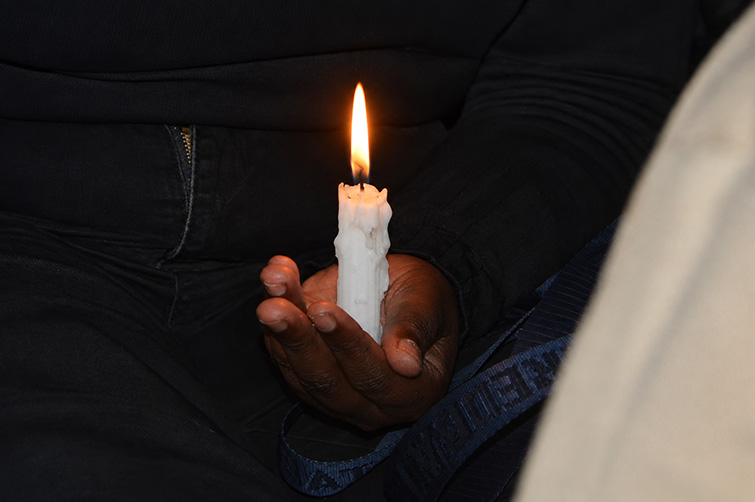 Staff and students gather for a candlelight vigil on the Qwaqwa Campus in solidarity against gender-based violence and femicide.
Beyond the placards: what comes after a day of protest?
In recent weeks, South Africa has seen renewed public anger over gender-based violence and femicide (GBVF) – ranging from memorial runs and shutdowns to smaller, quieter gestures, such as the candlelight vigils held across the University of the Free State (UFS) Bloemfontein, South, and Qwaqwa Campuses, where staff and students stood in silence in solidarity with survivors and in memory of women whose lives have been lost.
Moments such as these matter. However, they also raise a harder question: what happens after the candles are blown out and the placards come down? For a crisis this entrenched, a single day of visible anger, however sincere, cannot be the end of the response.
Nine lives, one crisis
Since mid-July 2026, the bodies of nine women have been found across Ekurhuleni – beside the R21, in the veld at Olifantsfontein, in a river at Clayville, on a roadside in KwaThema, and in Dawn Park. Only three have been identified; police say four were sexually assaulted.
It is a pattern that the data has long confirmed: the
HSRC's National GBV Study of 2022 found that more than 35% of South African women aged 18 and older have experienced physical or sexual violence in their lifetime, from partners and non-partners alike.
The vigils were – in that sense – a response not to a single incident, but to a crisis that has continued to deepen even after South Africa formally declared GBVF a national disaster in November 2025.
The state's duty, not a woman's burden
South Africa's Constitution leaves little room for ambiguity on where responsibility for that safety lies. Section 12(1)(c) of the
Bill of Rights guarantees everyone the right to be free from all forms of violence from either public or private sources – holding both street and home to the same standard.
Recently writing on this question for the University,
Prof Narnia Bohler-Muller, Research Theme Leader for Flourishing Life, argued that the burden of safety cannot be shifted onto women themselves through caution, curfews, or company. The duty, she wrote, belongs to the state – "it is not ours to discharge by staying indoors".
Gatherings such as Friday's vigils are one expression of what Bohler-Muller describes as a ‘plural right to appear’: people coming together publicly to insist on a safer, more liveable life for everyone, particularly for the women among us. It is an assertion that does not replace the state's obligations but refuses to let them go unspoken.
More than a single afternoon
Through these moments of unity, the UFS community reaffirmed its shared commitment to raising awareness, driving meaningful change, and building a safer, more compassionate campus and society for all.
The events in Ekurhuleni make it clear that commitment cannot end with a single afternoon of reflection; it must be carried into the everyday choices institutions make about safety, support, and solidarity.
From solidarity to organised action
Clinical psychologist and academic Anele Siswana says the challenge now is to turn the public consciousness created by protests into sustained action. “Solidarity has to become organised action,” he says. The question is not only what happens on the day of a protest, but what changes afterwards – in institutions, communities, and everyday life.
A national responsibility
Siswana brings this perspective to the national conversation through his appointment to the National Council on Gender-Based Violence and Femicide. In his recent UFS News profile, he describes the role as ‘a call to servant leadership and public service’, and argues that prevention, healing, accountability, and justice require the country to look beyond individual incidents to the conditions that allow violence to persist.
Accountability starts before violence
That perspective also places men and boys firmly within prevention efforts. Siswana argues for confronting harmful ideas about masculinity, power, and relationships, while strengthening understandings of consent, responsibility, and non-violence. Prevention, he says, has to begin before violence occurs, by challenging attitudes and behaviours that normalise misogyny and harm.
For Siswana, the real measure of a protest is what people, institutions, and leaders do afterwards. That is where the symbolism of the candles must become practical action, sustained accountability, and safer everyday environments.