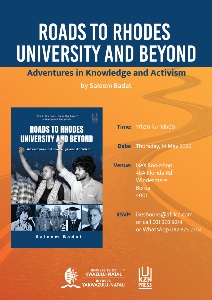
Roads to Rhodes University:
Adventures in Knowledge and Activism
April 2026. Approx. 432 pp. Softcover. 230 x 150 mm. ISBN: 978 1 86914 595 8.
Rights: World.
Saleem Badat’s association with universities spans over 50 years. Beginning as an anti-apartheid student militant and activist scholar, he has served as director of the Education Policy Unit at the University of the Western Cape, the first head of the Council on Higher Education, the advisory body to the Minister of Higher Education, the first black vice chancellor of Rhodes University and the first programme director of International Higher Education and Strategic Projects at the Andrew W. Mellon Foundation in New York.
This book comprises memoir, critical reflections on Rhodes and essays on leading and transforming universities and the contemporary university in South Africa. It is about predicaments, dilemmas and challenges under apartheid, during the early 1990s political transition and post-1994, and commitment to social justice and equity, development, quality and democracy. It is about Badat’s place in political and social movements, universities and other higher education institutions and the individual and collective efforts to dismantle apartheid and reshape institutions, policies and practices given new constitutional values and social goals. It is equally about navigating, resisting and overcoming in the knowledge, university, cultural and political arenas the legacies of colonialism and apartheid and the global hegemony of Western imperialism and Eurocentrism.
Saleem Badat is Research Professor in the Department of History at the University of the Free State. His books include Black Student Politics, Higher Education and Apartheid (2000), The Forgotten People: Political Banishment under Apartheid (2012), and Tennis, Apartheid and Social Justice (2023). He is the co-editor of Apartheid Education and Popular Struggles in South Africa (1991), Research and Activism: Ruth First and Activist Research (2025) and University of Durban-
Westville, 1961–2003: Undoing Apartheid, Building a Non-Racial Culture (2025). He is the author of over 50 research papers and newspaper articles.
His key awards include honorary doctorates from several universities, a Human Sciences Research Council/Universities South Africa award for Social Justice Scholarship, an Academy of Science of South Africa Science-for-Society Gold Medal, and the Inyathelo Exceptional Philanthropy Award for Excellence and Leadership in Personal South African Philanthropy.
‘Important and interesting, the book breaks new ground in the “tradition” of retired university leaders writing their memoirs. It will certainly rank amongst the best of these. It has gravitas and vision and promises to be the “go-to-text” on universities and higher education for the next generation’ (Anonymous peer reviewer).
‘Combines in rare degree political activism, academic publishing, a specialist knowledge of higher education, and leadership positions in national policy, universities and philanthropy.
The author draws on these experiences to write far more analytically and theoretically about leadership and universities than is the case in most memoirs by former vice chancellors or presidents’ (Anonymous peer reviewer).
‘Shows how the author’s actions as Vice-Chancellor were located in his thoughts about the post and the institution, and how these together amounted to the vision that is an integral part of leadership’ (Anonymous peer reviewer).
‘Three extremely important chapters on university leadership, universities and “transformation”, and the state of South African universities today’ (Anonymous peer reviewer).
The Research Project on the Histories of Universities in South Africa (RPHUSA) has three interrelated research goals:
- To produce a rigorously researched, well-written, peer-reviewed, scholarly book that analyses the purposes, roles and functions of universities between 1829 and today.
- To promote, support and to undertake, ideally in partnership with various universities, rigorous, critical, per-reviewed histories of individual, and especially historically black, universities in South Africa, as well as different groupings of universities (historically white, historically black, traditional universities, universities of technology, comprehensive universities) and
- To stimulate research on historical aspects of key issues related to universities – such as taken for granted core concepts, domains such as research, teaching and learning, community engagement, the origins and development of disciplines and fields, the academic development movement and student activism.
Beyond its research goals, the RPHUSA has other complementary goals. These are
- To publish the results of the research in the form of peer-reviewed books, book chapters and articles.
- To promote scholarly engagement on questions of concern to the research project through seminars, workshops and conferences, and
- To contribute to redressing the current social inequalities in the composition of the academy and knowledge creation through cultivating high quality scholars and researchers from historically disadvantaged social backgrounds by involving early career scholars, post-doctoral fellows and doctoral and masters students in the research project.
The coordinator of the RPHUSA is Prof Saleem Badat, Research Professor in the Department of History, University of the Free State. Prof Badat has extensive knowledge of universities and considerable research experience. He is the author of four books and some 60 book chapters and research articles. He is supported by a National Working Group of senior and promising early career scholars.