13 October 2026
|
Story Lunga Luthuli
|
Photo Ian van Straden
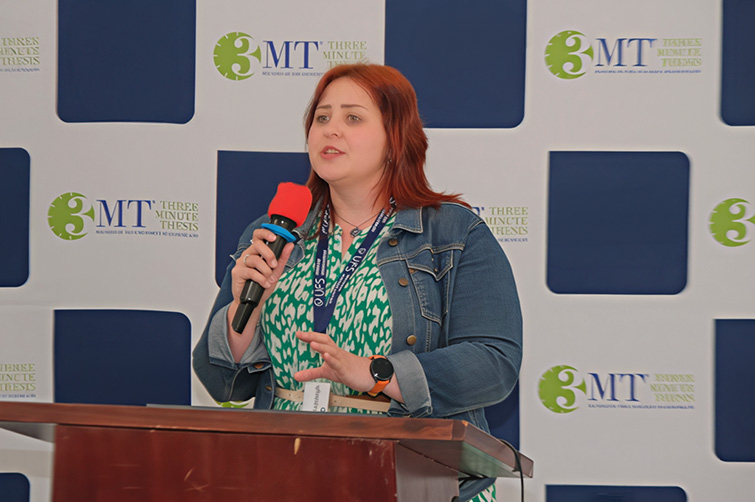 Maryna Hattingh, winner of the PhD category at the 2026 UFS Three-Minute Thesis Competition held for the first time on the Qwaqwa Campus.
The University of the Free State (UFS) is taking its Three-Minute Thesis (3MT) Competition to new heights. Following its first edition at the Qwaqwa Campus, the university is preparing to expand the initiative across the Southern African Development Community (SADC) region from 2027, creating new opportunities for postgraduate researchers to showcase their work and strengthen regional research collaboration.
UFS leads the way in research communication
The UFS first acquired the rights to host the 3MT Competition in 2013, becoming the first institution to introduce it to the African continent. Since then, the university has continued to grow the competition and encourage participation from other institutions.
“Every year we have asked other universities to participate. This year, for the national competition, we will have 13 universities participating, which is half of the public universities in the country and the most we have had over the years. It is important that we lead the sector, especially in research,” she said.
For Prof Vasu Reddy, Deputy Vice-Chancellor: Research, Innovation and Postgraduate Studies, the competition is about more than presenting the research. It equips emerging scholars to communicate their findings effectively and demonstrate the value of their work.
“Research excellence is not only measured by discovery. It is also measured by our ability to communicate knowledge with clarity, confidence, and purpose. For the UFS, 3MT is more than a competition. It is a powerful platform where the next generation of scholars learns to turn knowledge into responsible societal futures.”
Taking research beyond South Africa’s borders
Building on its national leadership, the UFS is preparing to extend the 3MT Competition into the SADC region, offering postgraduate researchers across Southern Africa a platform to share their work, develop their presentation skills and foster cross-border collaboration.
Dr Wessels said engagements with universities in Zimbabwe, Namibia and Botswana had begun in preparation for the planned regional expansion.
“A new initiative from 2027 is to take the competition to SADC. We have started engagements with universities in Zimbabwe, Namibia, and Botswana. It is important to grow research, firstly in the South. The sky is not the limit. Then later, we can take it further and compete with the global North,” she said.
Celebrating emerging UFS researchers
At the institutional competition on Thursday 8 October, 10 master’s students and 10 doctoral students competed for the top prizes. Five of the university’s seven faculties were represented, demonstrating the breadth of the postgraduate research taking place across disciplines.
Noxolo Phungula won the master’s category, while Maryna Hattingh took first place in the PhD category. Both researchers shared insights into their studies and reflected on what the recognition meant to them.
Phungula, an officer in the UFS
Directorate Research Development, presented her research, titled Exploring career paths and the development of support staff at a South African higher education institution. She credited her supervisor’s encouragement for helping her take part in the competition.
“After coming top at faculty level, there was that little hope that maybe I could do it again. I am grateful for the opportunity,” she said.
Hattingh, a lecturer in the
Department of Social Science and Commerce Education in the Faculty of Education, won the PhD category with her research, titled Reconceptualising theory-practice integration in creative arts teacher education: Towards a transformative framework for pre-service teacher development.
Her research grew out of observations during visiting schools, where she saw that student teachers were struggling to teach creative arts effectively.
“I found out that they do not really know how to teach arts. With the research, I focused on what theory they learn at university and how they go about their teaching practice. My study is to try and find a balance, helping them to do the teaching practice during their time as students and make the transition to the classroom easier,” she explained.
Giving emerging researchers a voice
The achievements of Phungula and Hattingh highlight the value of platforms such as the 3MT Competition in helping emerging researchers communicate their work, build confidence and contribute to the advancement of research at UFS and beyond.
Phungula encourages fellow researchers to choose topics they are passionate about, as this enables them to become advocates for the people whose experiences inform their studies.
Her research focuses on entry- to mid-level support staff, whose contributions are essential to the functioning of higher education institutions but who remain under-represented in research, particularly in the Global South.
“My research focused on entry- to mid-level staff as the backbone of an institution, and there is not much research on support staff and far less in the Global South. It was important for me to have a voice out there and for career pathways to become a strategic move for institutions, and investment in their people,” she said.
By bringing these issues into the spotlight, her research highlights the importance of recognising support staff, developing clear career pathways and investing in the people who help institutions function effectively.
As the UFS looks towards expanding the competition across the SADC region, the achievements of Phungula and Hattingh reflect the quality, relevance and diversity of research emerging from its postgraduate community. Their success also reinforces the university’s commitment to research excellence, knowledge sharing and collaboration across South Africa and beyond.
“I am inspired by the calibre of research emerging from our postgraduate community. Congratulations to all our finalists and winners whose work exemplifies curiosity, creativity and commitment,” said Prof Reddy.
Institutional winners
Master’s category
First prize: Noxolo Phungula Sinegugu - Faculty of Economic Management Sciences
Second prize: Henry Gurajena - Faculty of Economic Management Sciences
Third prize: Mpho Patience Metsing - Faculty of Education
PhD category
First prize: Maryna Hattingh - Faculty of Education
Second prize: Dr Elizabeth Brits - Faculty of Health Sciences
Third prize: Moreblessing Chipangura - Faculty of Economic Management Sciences