23 December 2025
|
Story André Damons
|
Photo Kaleidoscope Studios
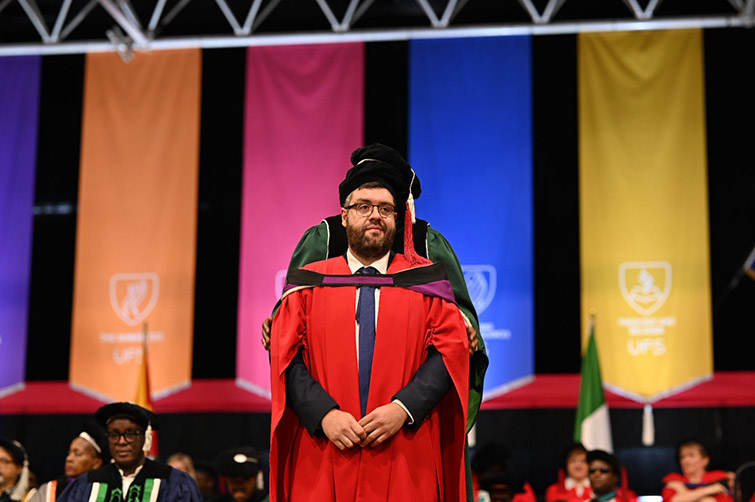 Dr Jean Kloppers, Medical Scientist in the Department of Haematology and Cell Biology at the University of the Free State (UFS), with his supervisor, Prof Wattie Janse van Rensburg, after his graduation.
Dr Kloppers crossed the stage on Friday (12 December) during the UFS Faculty of Health Sciences graduation ceremony with a PhD in Biomedical Science with specialisation in Human Molecular Biology. He says earning the highest qualification has been a long-standing goal and he is grateful for the opportunity to complete a PhD.
“Completing the degree while working full time and leading my own research group made the accomplishment even more meaningful. Earning a PhD has opened the door to new and exciting opportunities that I look forward to exploring. Reaching this goal – through dedication, hard work, and perseverance – brings me immense relief and pride,” says Dr Kloppers.
According to him, the University of the Free State has been his academic home since his first year as an undergraduate student. Having now completed all four of his degrees at this institution, the journey feels both meaningful and complete. “It has been a humbling experience that continually challenged and shaped me, allowing me to discover the extent of my abilities and personal resilience.”
Why do this research
Dr Kloppers explains his reason for undertaking this study, titled Mutational analysis of people with Haemophilia A in a central South African population is because Haemophilia A – and particularly the genetic landscape of this condition – has been significantly understudied in South Africa. It was therefore important for him to develop a diagnostic platform that could serve as a national reference centre of excellence for Haemophilia A testing. Through this research, they have successfully achieved that goal.
“This field of study was chosen for two key reasons: firstly, the notable lack of locally generated knowledge on the condition in South Africa, and secondly, my many years of working with bleeding disorders, which have fostered a deep passion to advance understanding in this area. Through this research, I hope to make a meaningful contribution to improving the comprehensive care of patients across Africa.
“The gap in the research of genetic landscape of Haemophilia A in South Africa has limited patients’ access to accurate and comprehensive genetic counselling. By establishing this testing platform and describing genotype–phenotype correlations, our work will help bridge this gap and strengthen the quality of care available to patients,” explains Dr Kloppers.
Improved access to comprehensive care model
The research identified several novel genetic variants in the F8 gene that explain the underlying cause of Haemophilia A in affected individuals. In addition, he continues, they have developed a cost-effective genetic testing platform that has the potential to serve as a reference system for the entire African region.
“Importantly, by pinpointing the causative variants in our patient population, we are enabling patients and their families to access more accurate diagnoses and comprehensive care models. My hope is that this research will translate directly into routine diagnostic practice and that individuals living with Haemophilia A will benefit from improved access to the comprehensive care model we propose.”
Prof Janse van Rensburg congratulated Dr Kloppers on achieving his PhD in Human Molecular Biology. Having been an undergraduate lecturer and subsequent supervisor for all three of Dr Kloppers’ postgraduate degrees, Prof Janse van Rensburg expressed that it has been a true privilege to witness Dr Kloppers' remarkable journey from an undergraduate student to becoming a distinguished researcher in the field of haemophilia. “Dr Kloppers' dedication and perseverance have been inspiring, and I am incredibly proud of all that he has accomplished, a success that is well deserved with anticipation for the impact he will continue to make in the field.”